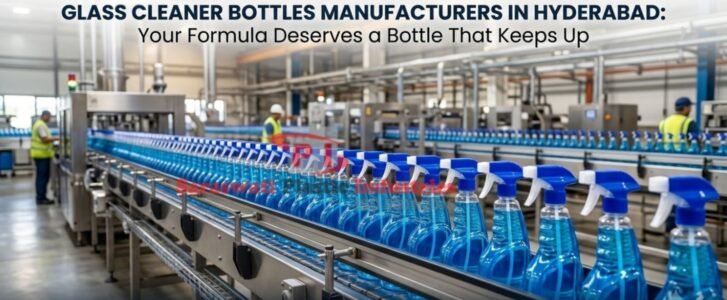
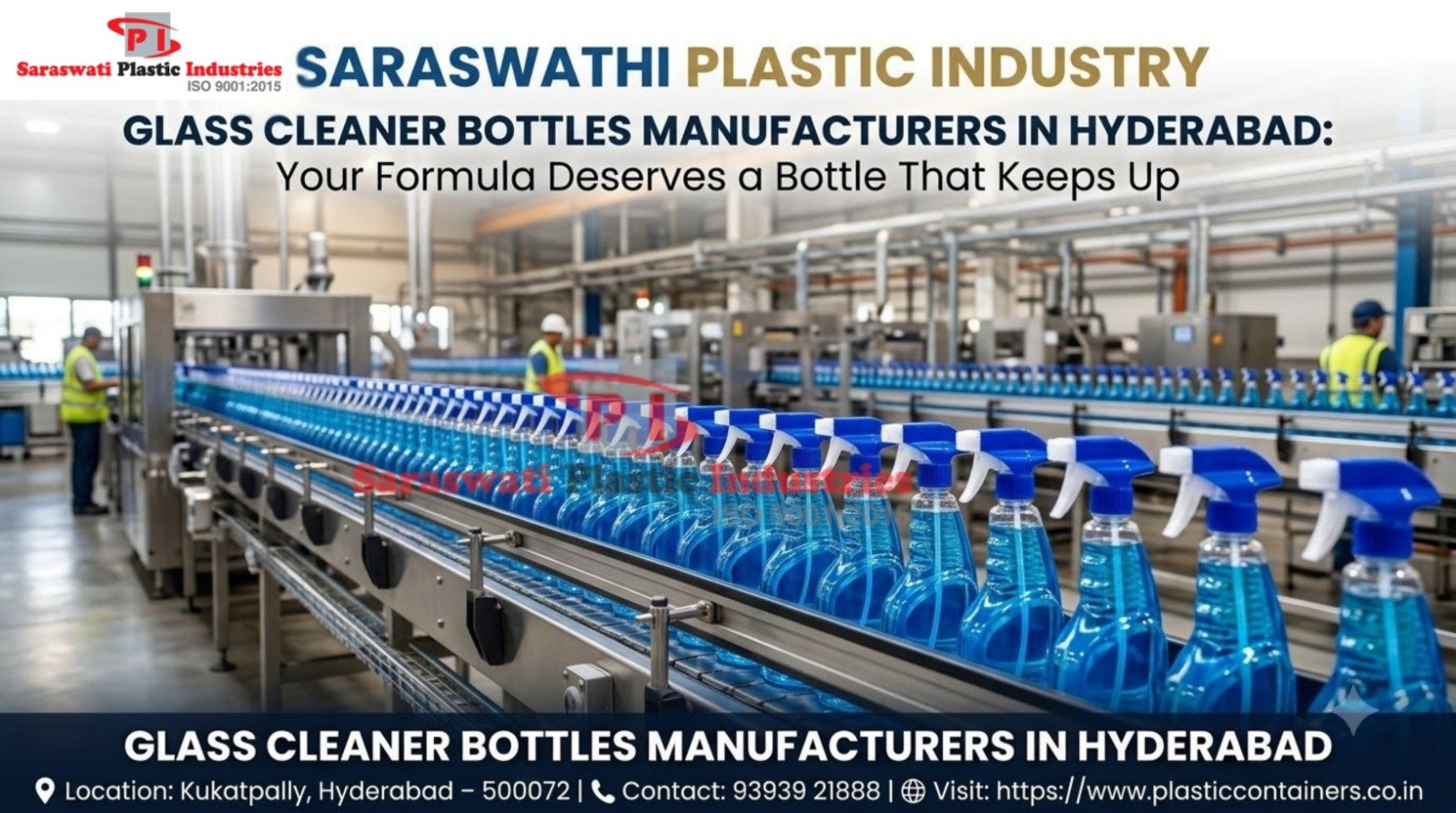
Glass Cleaner Bottles Manufacturers in Hyderabad: Your Formula Deserves a Bottle That Keeps Up
Call: 93939 21888
Glass Cleaner Bottles Manufacturers in Hyderabad matter most to people like you: businesses that make glass cleaner and need the right bottle to put it in. You’ve sorted the formula, the price and the label. Now the bottle decides whether all that effort reaches your customer in one piece. Saraswati Plastics, based in Kukatpally, manufactures HDPE bottles and supplies them directly, so you can order from the people who actually make them.
Glass Cleaner Bottles Suppliers in Hyderabad
Glass Cleaner Bottles Suppliers in Hyderabad are the other half of the plan, because a filling line doesn’t wait politely when bottles run late. If you produce glass cleaner, you need a supplier who delivers when your batch is ready, not a week afterwards. At Saraswati Plastics, manufacturing and supply sit together, so your reorders don’t get lost between two companies.
A Production Day, and Everywhere a Bottle Can Wreck It
Picture an ordinary day at your unit:
8 am: Cartons of empty bottles arrive. Is the count right? Is anything crushed?
9 am: The line starts. Do the bottles feed through and stand straight?
11 am: Filling and trigger fitting. Do the sprayers thread on cleanly, or do you fight each one?
1 pm: Labels go on. Does the sticker sit smooth, or wrinkle at the curve?
3 pm: Filled bottles are packed. Does one carton come out damp?
5 pm: Dispatch. Will every bottle still be fine in a retailer’s store room next week?
Every single step depends on the bottle. A fault at any of them costs you a morning, a batch or a customer. That’s why choosing a bottle partner is a production decision, not a shopping errand.
Your Formula Meets the Plastic
Most glass cleaners are mostly water with a bit of alcohol, a mild solvent, a surfactant, some dye and a light fragrance. Some use ammonia. It’s a thin liquid, and it behaves very differently from a thick soap or a strong acid.
HDPE copes well with most of these formulas, which is why it’s the standard for household cleaning bottles and the material Saraswati Plastics makes. PET is the clear alternative, but it can be less relaxed about certain solvents.
Whichever you pick, test with your own liquid. A formula that’s slightly stronger than usual, or a dye that fades in light, can behave differently from what a datasheet promises. A week with a filled sample tells you more than any brochure.
HDPE or PET? A Maker’s View
Here’s how it looks from your side of the line.
HDPE is tough and forgiving. It’s semi-opaque, survives knocks in transit and rarely complains about cleaning chemicals. It’s a good fit if you deliver to retailers across the city and don’t want breakage.
PET is clear, so your blue glass cleaner glows on the shelf. It looks premium, but it needs a closer look at your formula and at how your cartons travel.
Neither is “better.” Pick the one that suits your formula, your transport and your brand, and ask your supplier to say honestly which one they’d choose for your product.
The Neck, the Trigger and Your Filling Line
For a glass cleaner maker, the neck of the bottle is where most headaches start.
Neck size. The trigger sprayer must match the bottle neck. A 28 mm neck is very common, but confirm it against the exact sprayer you buy.
Consistency. Every bottle in a batch should have the same neck, height and weight. Small differences make triggers cross-thread or bottles tip on a conveyor.
Dip tube length. Too long, and it bends. Too short, and you leave liquid behind.
Lock setting. A twist-lock nozzle stops leaks in cartons and trucks.
Bring your sprayer with you or share its specification. Two parts that were never introduced rarely get along, and it’s far easier to fix a mismatch on a sample than on ten thousand bottles.
What a Filling Line Really Wants
Line operators don’t talk about elegant shoulders. They talk about bottles that behave. Here’s what they like:
Bottles that stand upright without leaning
Even weight across a batch
A smooth, flat label panel
Clean, undamaged necks
Packing that arrives dry and intact
None of this sounds dramatic. All of it decides whether your line runs smoothly or spends the afternoon being fixed.
Manufacturer, Supplier or Both?
These two words get mixed up all the time, so here’s the plain version for your side of the table.
A manufacturer makes the bottles. The team runs the machines, chooses the plastic and controls the quality. A supplier gets them to you: stock, restocks, smaller lots and quick top-ups. As a glass cleaner maker, you need both.
Here’s the catch. If you buy from a supplier who doesn’t make the bottle, you’re one step away from the person who can fix a problem. If you buy from a factory that only deals in huge lots, you’re stuck with minimums you can’t use.
That’s why working with Glass Cleaner Bottles Manufacturers in Hyderabad who also handle supply makes life easier. At Saraswati Plastics, a question about the neck goes to the people who produce the bottle, and a reorder goes to the same phone number as your first order. One relationship, not two.
How Working With Saraswati Plastics Goes
It’s meant to be simple:
Call or message with your bottle size, sprayer type (or neck size), the kind of glass cleaner you make and roughly how many bottles you need to start.
Ask for a sample and fill it with your real product.
Try it on your filling line, then tell the team what you notice.
Place a first order at a size that suits your production.
Reorder without starting from scratch.
No long forms, no long waits. Just a conversation with the people who make the bottle.
Who Usually Gets in Touch
Businesses that need these bottles are usually makers of one kind or another:
Small brands launching their own glass and household cleaners
Home-based producers scaling up to a proper small unit
Private-label makers filling for retail brands
Janitorial and housekeeping-chemical manufacturers
Car-care chemical makers who sell windscreen and glass cleaner
Each has different volumes and different priorities. A startup wants low minimums. A private-label filler wants consistency across large batches. Tell Saraswati Plastics which one you are and the conversation gets short and useful.
Starting Small, Growing Steadily
Many new makers order thousands of bottles because the per-piece price drops. It’s tempting. It’s also how people end up with a store room full of the wrong sprayer.
Start with a first batch that covers a few weeks of your sales. Watch how the bottles behave on your line. Then scale up. Glass Cleaner Bottles Suppliers in Hyderabad that also manufacture can talk about smaller trial lots first and better rates as your volumes grow. Ask Saraswati Plastics about minimum quantities when you call, so you know where you stand before you commit.
Spray Bottles and Refill Cans Together
Plenty of your customers, from offices to housekeeping firms, won’t want a new spray bottle every time. They buy a 5-litre can and refill the bottle they already own. It’s cheaper for them, and it keeps plastic in use for longer.
If you make glass cleaner, selling both a spray bottle for the shelf and a refill can for regulars widens your market. Ask your Glass Cleaner Bottles Suppliers in Hyderabad about 5-litre cans alongside the spray bottles, so one order covers both.
Labels, Colours and Your Brand
Your bottle is your billboard. A few simple choices help your glass cleaner stand out:
A flat label panel so stickers or printed labels sit neatly
A trigger colour that matches your label
A clear or tinted bottle, chosen on purpose, depending on whether you want the blue to show or the formula shielded from sunlight
You don’t need a fancy mould. A plain bottle with a matched trigger and a tidy label looks confident beside bigger brands.
Planning Your Stock
Running out of bottles is the quiet disaster of small production units. The formula is ready, the labels are ready, and the cartons of empty bottles are three days away.
A simple habit helps: decide how many weeks of bottles you want in hand, and reorder when you reach that level. Share your monthly plans with your supplier, especially before festivals and the summer rush, when cleaning products sell faster. A supplier who knows what’s coming can plan for it, and you’re far less likely to face a gap.
The Real Cost of a Cheap, Weak Bottle
It’s easy to compare quotes by looking only at the price per bottle. But a leaking bottle costs you the bottle, the product inside, the carton it dampened and a bit of your retailer’s patience.
If a few cartons per batch come back, the saving on the cheaper bottle disappears fast. A slightly better bottle that arrives consistent, fits your sprayer and stays dry in transit usually costs less once you count everything. Ask for the full price, including caps or liners and delivery, so you compare like with like.
Why Staying Local Pays Off
Most online listings for these bottles are a line of specs: size, material, price per piece. That’s handy, but it never tells you what happens when something goes wrong. That’s where location starts to matter.
When you work with Glass Cleaner Bottles Manufacturers in Hyderabad, you can visit the unit, hold the bottle in your hands and meet the person who’ll answer your call. Freight is lower, delivery is quicker, and a change in sprayer or colour doesn’t mean waiting on a truck from another state. Saraswati Plastics is in Kukatpally, so if your unit is in or around the city, it’s a short trip, not a research project.
A Quick Test Before You Order
You don’t need a lab. You need a sample bottle, your actual glass cleaner and a bit of curiosity.
Fill the bottle with your real product and fit your real sprayer.
Spray fifty times. Does the mist stay even?
Turn it upside down on a tissue for a few hours. Any dampness?
Lock the nozzle and shake it hard. Does anything leak?
Leave it filled for a week. Look for softening, stains or a change in smell.
Run a few through your line if you can. Do they stand, fill and label cleanly?
Write down what you notice and share it with your supplier. How they respond tells you a lot.
Wrapping Up
You’ve worked hard to make a glass cleaner that leaves windows spotless. The bottle should never be the reason a customer doubts it.
So take your time, test a sample and ask the awkward questions. Whether you’re comparing Glass Cleaner Bottles Manufacturers in Hyderabad for a custom run or checking Glass Cleaner Bottles Suppliers in Hyderabad for a quick restock, the best answer is one team that does both.
That team is Saraswati Plastics, a manufacturer and supplier of HDPE bottles in Kukatpally, Hyderabad. Call 80746 92090 or visit plasticcontainers.co.in to ask for a sample.
Frequently Asked Questions
1. Is Saraswati Plastics a manufacturer or a supplier? Both. Saraswati Plastics manufactures HDPE bottles and supplies them to businesses from Kukatpally, Hyderabad, so you deal with one team for production and reorders.
2. Which plastic should I choose for my glass cleaner formula? HDPE is the common choice for household cleaning products, and PET is the clear alternative. Test either one with your own formula first, especially if it contains alcohol, solvents or ammonia.
3. Can I test a sample on my filling line before ordering in bulk? You should. Ask Saraswati Plastics for a sample, fit your own trigger sprayer, fill it with your real product and run it through your line before you commit to a larger order.
4. What neck size do trigger sprayers need? A 28 mm neck is very common, but sizes vary between sprayers. Confirm the neck finish against your exact sprayer before ordering.
5. How many bottles should I order first? Start with enough for a few weeks of sales. It lets you check how the bottles behave on your line before you scale up.
6. How do I get a quote from Saraswati Plastics? Call 80746 92090 or visit plasticcontainers.co.in, and share your bottle size, sprayer type, the kind of glass cleaner you make and how many bottles you need to start.